New World Screwworm: Fact Sheet & SHIC Article 6/10/2026 & USDA NWS Website & SHIC/AASV NWS Webinar (8/4/2026)
The Swine Health Information Center funded the development and expansion of the Standardized Outbreak Investigation Program (SOIP) to address a critical gap in swine biosecurity. Dr. Derald Holtkamp, Iowa State University, leads the program, which offers online access, standardized resources, and reporting of outcomes for producers and their veterinarians to use in the event of a disease outbreak. While many biosecurity control measures exist, little research has focused on identifying the specific hazards and pathogen entry routes those measures are intended to prevent. Consequently, biosecurity resources are often applied inefficiently. SOIP uses disease outbreak investigations as opportunities to conduct systematic biosecurity hazard analyses, identify likely pathways of pathogen introduction, and prioritize risks that warrant intervention.
Find the entire project report for SHIC project #25-053 here.
SOIP strengthens the infrastructure needed to translate outbreak investigation findings into practical biosecurity improvements across the US swine industry. By improving data collection, training, reporting, and industry participation, SOIP provides a framework for identifying significant risks, prioritizing interventions, and improving preparedness for emerging and transboundary animal diseases. The long-term goal is to enhance herd health, productivity, and the global competitiveness of the US pork industry through more effective, evidence-based biosecurity practices.
Launched in January 2024, SOIP enables veterinarians and producers to conduct standardized outbreak investigations and securely store findings in a centralized database. By aggregating information across multiple investigations, the system allows the swine industry to identify recurring biosecurity risks and learn from collective experiences. The recently completed project’s objectives were to provide ongoing support for the SOIP platform, improve training resources, increase adoption of the application, enhance database and data extraction capabilities, and develop company- and industry-level benchmarking reports.
The SOIP web-based application and investigation database are maintained and supported by Iowa State University’s Department of Veterinary Diagnostic and Production Animal Medicine. Supported activities include user management, technical troubleshooting, software improvements, and maintenance of a dedicated support email address ([email protected]). Adoption of the platform continues to grow. As of June 1, 2026, there have been 124 investigations conducted using the SOIP web-based application.
To assist with the use and application of SOIP, training resources were developed through collaboration with SES Inc., resulting in two comprehensive training modules, including 17 videos covering both application use and outbreak investigation methodology (Table 1).
Table 1. SHIC training videos available for SOIP.
Module 1
Episode 1: The Organization of the SOIP
Episode 2: How to Add a Company Representative in the SOIP
Episode 3: Who Can Delete Sites, Users, and Companies in the SOIP
Episode 4: How to Set Up Sites and Build Site Maps in the SOIP
Episode 5: How to Delete or Edit Existing Sites in the SOIP
Episode 6: Overview of the Pre-Investigation Survey Section of the SOIP
Episode 7: Overview of the Questionnaire Section of the SOIP
Episode 8: How to Edit an Existing Investigation in the SOIP
Episode 9: How to Update Master Mapping Information in the SOIP
Episode 10: How to Unlock a Locked Investigation in the SOIP
Episode 11: How to Interpret a Detailed Report in the SOIP
Episode 12: How to Interpret an Executive Summary in the SOIP
Module 2
Episode 1: The Purpose of the SOIP
Episode 2: Terminology Used in the SOIP
Episode 3: The Process for Conducting an Outbreak Investigation – The Investigation Phase
Episode 4: The Process for Conducting an Outbreak Investigation – The Investigation Form
Episode 5: The Process for Conducting an Outbreak Investigation – The Post-Investigation Phase
SOIP adoption is encouraged through industry engagement, including meetings, demonstrations, outreach articles, and direct collaboration with producers and veterinary clinics. A widely distributed article, Lessons Learned from SHIC’s Standardized Outbreak Investigation Program to Date, summarized major findings from completed investigations and highlighted opportunities for improving biosecurity across the industry.
A written document, the SOIP User Support Guide, covers the same contents as the Module One video. The written guide is available here.
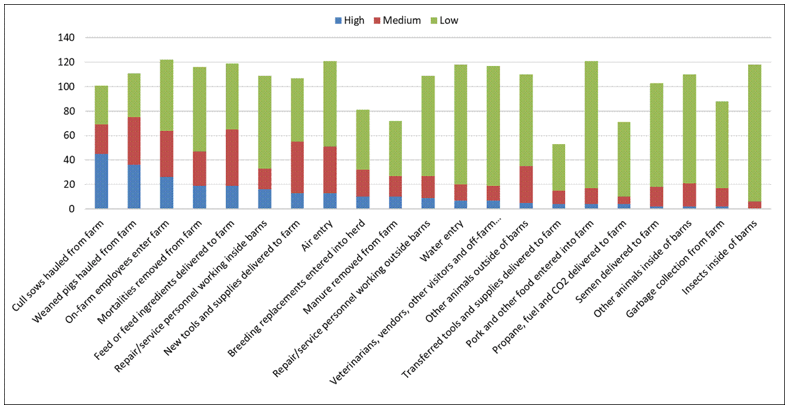
SOIP database functionality has been enhanced to allow users to export investigation data directly to Excel with customizable filters. Additionally, company- and industry-level benchmarking reports were developed to compare the frequency of pathogen entry events and associated hazard ratings (Figure 1). These reports help companies identify strengths, weaknesses, and opportunities for improvement in their biosecurity programs. Preliminary work also demonstrated the potential to use artificial intelligence tools to analyze narrative investigation data and identify common themes.
Figure 1. Frequency of hazard ratings by entry event, ranked by the number of times rated high.
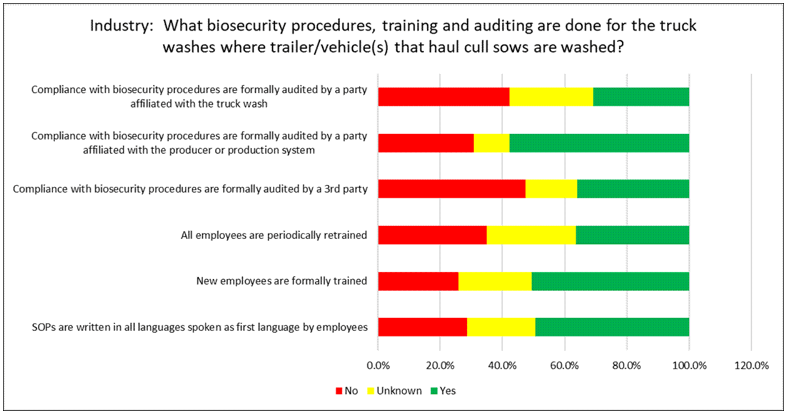
The web-based application can also allow for aggregation of investigation data that can help identify and characterize hazards for key areas of production such as cull sow transportation. Examples of information that can be gained from industry reporting include the identification of risks for disease entry such as lack of decontamination procedures in Figure 2 and for high-risk trailers due to limited auditing or assessment of truck wash procedures noted in Figure 3.
Figure 2: Industry summary of the decontamination procedures used to haul cull sows.
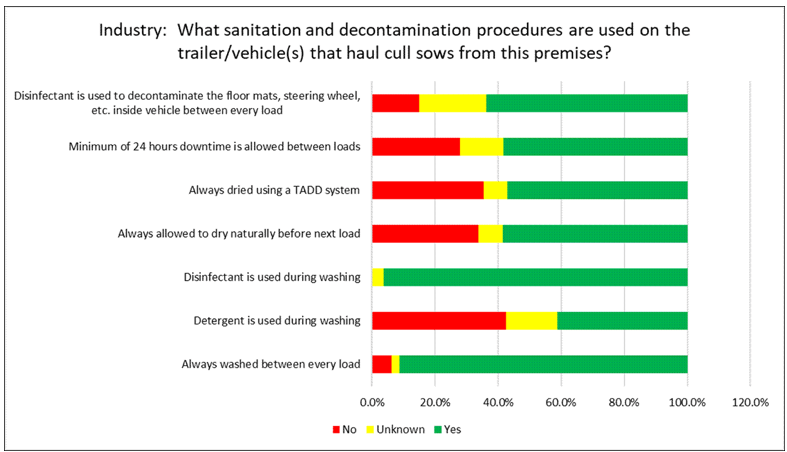
Figure 3: Industry summary of biosecurity procedures at cull sow trailer/vehicle truck washes.
In addition, the program can identify information for key biosecurity areas such as assessment of risks and hazards associated with cull sow removal which are consistently identified as:
An inherently high-risk process driven by:
▪️Human compliance variability
The greatest vulnerabilities occur at:
▪️Loadout areas (failure to prevent pathogen entry into barns)
The SOIP provides a systematic, standardized, and comprehensive outbreak investigation and biosecurity hazard analysis for veterinarians and pork producers both pre and post pathogen introduction. Utilizing the collective findings, gaps in US swine herd biosecurity can now be identified more rapidly, and solutions applied, to decrease the incidence of disease outbreaks over time, increase herd productivity, and improve global competitiveness. This improvement in biosecurity will help prevent the introduction of transboundary diseases to the US, and when transboundary diseases are introduced, veterinarians and pork producers will be ready to respond by identifying the most significant biosecurity hazards and routes of transmission to help slow spread.