New World Screwworm: Fact Sheet & SHIC Article 6/10/2026 & USDA NWS Website & SHIC/AASV NWS Webinar (8/4/2026)
The Swine Health Information Center funded a study to develop a viral smoke detector-like device for use in swine barns to autonomously detect viral pathogens directly from air in a continuous fashion. The study was led by Dr. Igor Paprotny, Department of Electrical and Computer Engineering at the University of Illinois Chicago, in collaboration with Dr. Michael Caffrey, College of Medicine at University of Illinois Chicago and Drs. Ying Fang and Joseph Connor, College of Veterinary Medicine, University of Illinois Urbana-Champaign. During the study, the research team developed several viral smoke detector-like prototypes, adapted from the bioAerium airborne pathogen sensing platform previously invented by Drs. Paprotny and Caffrey, to operate in swine farm environments. Results showed the prototypes were able to consistently detect PRRSV with sensitivity comparable to that obtained through oral fluid sampling. Pork producers and their veterinarians would consequently have an effective, inexpensive, less hands-on method for virus detection, should the prototype be further refined and developed for commercial use.
Find the industry summary for SHIC project 24-078 here.
Key Producer Outcomes:
The overarching goal of the project was to develop a new biosecurity tool to allow producers to reduce losses to their swine population through active monitoring and early outbreak detection. The more specific objective of this project was to adapt the bioAerium platform, a real-time detector for airborne viral pathogens (called a viral smoke detector) for rapid sensing of airborne swine viruses. The smoke detector performance was to be validated in actual swine farm environments. Most notably, the sensor uses nucleic acid amplification (NAA) techniques to achieve high sensitivity necessary for real-time airborne pathogen detection. Specifically, aerosol collection is automatically followed by an NAA technique called LAMP. LAMP has a comparable sensitivity to polymerase chain reaction but avoids temperature cycling, facilitating use in an inexpensive field-deployable device. The project initially focused on three target viruses: PRRSV, IAV-S, and PEDV. However, based on feedback from producers, the focus switched to PRRSV largely due to its significant impact on domestic swine production, and because the sensor can be easily adapted to detect other target viruses by simply swapping target reagents.
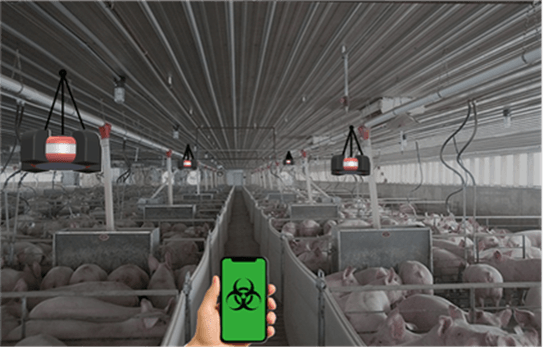
Once commercialized, these viral smoke detectors are expected to be inexpensive and able to simultaneously test for multiple viral pathogens. A network of such sensors deployed throughout the farm (see Figure 1) could potentially enable producers to continuously obtain a real-time snapshot and support early detection of essentially any airborne infections in their swine population. Dr. Paprotny and his team noted that the results indicate that these prototype viral smoke detectors could be used as an effective tool for continuous monitoring of viral infections in swine populations and can assist the producers in early identification of emerging outbreaks.
The Swine Health Information Center, launched in 2015 with Pork Checkoff funding, protects and enhances the health of the US swine herd by minimizing the impact of emerging disease threats through preparedness, coordinated communications, global disease monitoring, analysis of swine health data, and targeted research investments. As a conduit of information and research, SHIC encourages sharing of its publications and research. Forward, reprint, and quote SHIC material freely. For more information, visit https://www.swinehealth.org or contact Dr. Lisa Becton at [email protected]