
In alignment with SHIC’s efforts to identify global swine disease threats to the US pork industry, the recent emergence and spread of FMDV SAT1 serotype is being closely monitored. The SHIC-funded Global Swine Disease Monitoring Reports, led by Dr. Sol Perez at the University of Minnesota, have highlighted the newly affected countries in monthly publications. To summarize the situation, Dr. Perez and her team have prepared the following article on the historic prevalence and current expansion of FMDV serotype SAT1, one of seven FMDV serotypes.
For FMDV, immunity is serotype-specific, meaning infection or vaccination against a given serotype does not confer protection against a different serotype. Historically, SAT1 has been confined to sub-Saharan Africa, with transmission largely maintained in endemic locations in East and Southern Africa. In 2025, SAT1 demonstrated a notable and concerning expansion beyond its traditional geographic range, with confirmed detections of two cocirculating subtypes (topotypes) of FMDV, SAT1/I and SAT1/III, across Western Asia and North Africa. The increasing circulation of FMDV serotype SAT1 poses a growing risk to previously unaffected regions, including South-East Europe and potentially beyond. As this serotype expands its geographic range, it creates additional pathways for introduction into new regions and countries, thereby increasing the overall likelihood of transboundary spread.
This briefing provides an overview of the historical range of the SAT1 serotype and analyzes its recent spread beyond established endemic zones. It also examines potential factors contributing to this dispersal and the resulting consequences for both endemic regions and countries free from FMD, such as the United States.
Historical distribution and epidemiologic context
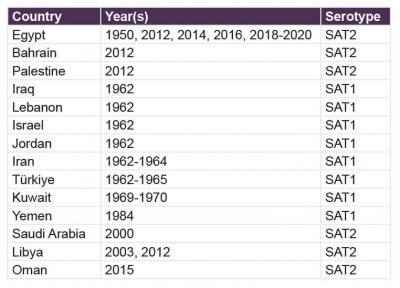
The historical occurrence of FMDV SAT serotypes outside sub-Saharan Africa has been relatively limited and characterized by sporadic incursions rather than sustained transmission. Early detections of SAT1 were reported across several countries in West Asia during the 1960s, including Iraq, Lebanon, Israel, Jordan, Iran, Türkiye, and Kuwait, followed by a later occurrence in Yemen in 1984. In contrast, SAT2 has been detected intermittently in North Africa and the Middle East, with notable events in Egypt, Bahrain, Palestine, Saudi Arabia, Libya, and Oman between 1950 and 2015. These historical patterns indicate that, before 2023, SAT serotypes were occasionally introduced into regions outside their endemic range but did not establish widespread or persistent circulation, in contrast to the more recent expansion observed in the current epidemiological landscape. The historical occurrence of FMD serotypes SAT1 and SAT2 is presented in table 1.
Table 1. Historical occurrence of FMDV SAT Serotypes outside sub-Saharan Africa (pre-2023)
Recent emergence and spread of FMDV SAT serotypes outside sub-Saharan Africa (2023-2026)
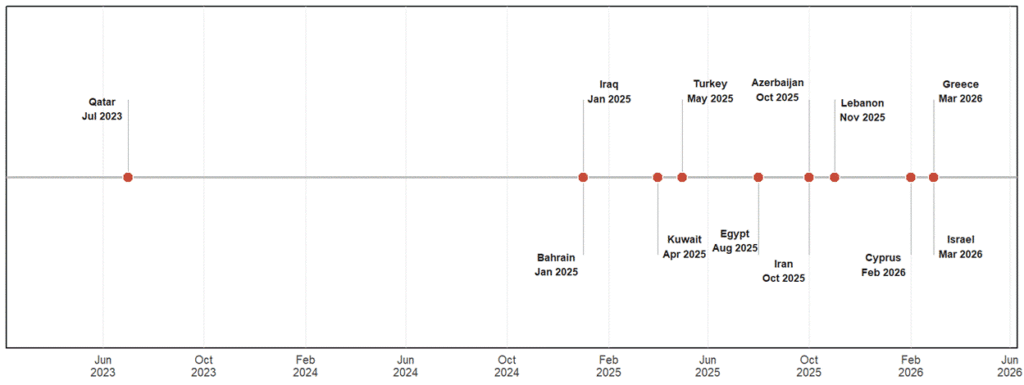
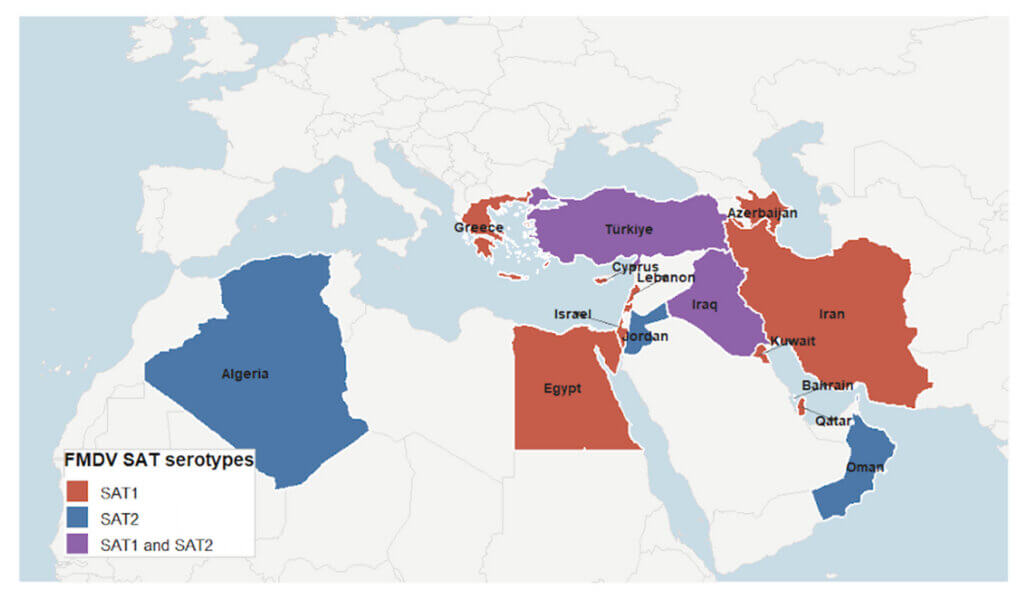
In 2023, confirmed reports of FMDV serotype SAT1 were reported in Qatar and Jordan, and SAT2 in Oman, Türkiye, and Bahrain. From 2025 onward, SAT1 expanded rapidly, with confirmed detections in Iraq, Kuwait, Türkiye, and Egypt, followed by further spread into Azerbaijan, indicating northward expansion into the Caucasus. Continued transmission was observed with subsequent detections in Lebanon, Israel, Cyprus, and Greece in 2025-2026. During this period, SAT2 persisted in Algeria and Bahrain, reflecting ongoing co-circulation in some regions. These patterns suggest a transition from sporadic SAT detections to a broader and more sustained geographic presence of SAT1 across the Eastern Mediterranean, West Asia, and North Africa. Figure 1 presents a timeline of SAT1 outbreaks occurring outside endemic regions between 2023 and 2026, while Figure 2 is a map illustrating the countries affected by both SAT1 and SAT2 during that same timeframe.
Implications for disease control in the affected countries
The emergence of FMDV serotype SAT1 across the eastern Mediterranean, West Asia, and North Africa exposes critical vulnerabilities in existing control systems within endemic countries. Most vaccination programs in these regions are designed around historically occurring serotypes O, A, and Asia-1, providing no cross-protection against SAT1 and leaving livestock populations effectively susceptible despite routine vaccination. This risk is compounded by the limited availability of SAT1-containing vaccines, gaps in surveillance, and variable veterinary service capacity. A recent FAO rapid risk assessment further highlights that informal cross-border animal movements, particularly of small ruminants that may be subclinically infected, are a major driver of transmission, with seasonal increases in livestock movement during religious periods further amplifying spread. Together, these factors create conditions for rapid and often undetected dissemination of SAT1, which increases the likelihood of unexpected outbreaks, reduces the effectiveness of current control strategies, and presents a significant economic and food security risk, particularly in smallholder-dominated systems.
Potential drivers of SAT1 spread
The expansion of FMDV serotype SAT1 is likely due to several interconnected factors. Increased informal transboundary livestock movement is a primary driver of rapid dissemination. Environmental pressures, such as drought and land-use change, enhance spillover opportunities from wildlife reservoirs into domestic herds at the wildlife-livestock interface. Gaps in vaccination strategies, which often target serotypes O and A, leave populations vulnerable and create ecological space for SAT1 to spread. Although improved surveillance contributes to detection, the speed and extent of the recent spread point to a true epidemiological expansion, not merely an artefact of reporting.
Implications for the United States
The ongoing expansion of FMDV serotype SAT1 has important implications for FMD-free countries, including the United States, because it increases both the complexity and uncertainty of global FMD risk. The emergence of SAT1 in new regions adds to the diversity of circulating serotypes in those regions, complicating preparedness and response planning, particularly when vaccine stockpiles may not include well-matched SAT1 strains. At the same time, continued transboundary spread heightens the risk of introduction through established pathways such as international travel, contaminated animal products, and fomites. Although the United States remains free of FMD, these global developments underscore the need to strengthen early detection and surveillance systems, maintain stringent biosecurity measures across livestock value chains, and ensure that vaccine preparedness strategies are sufficiently flexible to incorporate emerging serotypes such as SAT1.
References
The Swine Health Information Center, launched in 2015 with Pork Checkoff funding, protects and enhances the health of the US swine herd by minimizing the impact of emerging disease threats through preparedness, coordinated communications, global disease monitoring, analysis of swine health data, and targeted research investments. As a conduit of information and research, SHIC encourages sharing of its publications and research. Forward, reprint, and quote SHIC material freely. For more information, visit http://www.swinehealth.org or contact Dr. Megan Niederwerder at [email protected] or Dr. Lisa Becton at [email protected].