New World Screwworm: Fact Sheet & SHIC Article 6/10/2026 & USDA NWS Website & SHIC/AASV NWS Webinar (8/4/2026)
To better understand how swine viruses spread during transport, the Swine Health Information Center funded a Wean-to-Harvest Biosecurity Research Program study focused on the unloading process at the harvest plant, in partnership with the Foundation for Food & Agriculture Research and Pork Checkoff. Led by Drs. Cesar Corzo and Lucas Ferreira at the University of Minnesota, the study tracked the presence of four major pathogens affecting the swine industry as a method to assess trailer contamination dynamics during unloading. Additional objectives were to identify key factors such as season, cleaning practices, and driver behaviors that influence contamination risk. Proper washing, disinfection, and drying of trailers significantly reduce viral contamination risk, while seasonal conditions strongly influence virus presence, requiring adjusted biosecurity strategies year-round.
Read the industry summary of study #24-077 here.
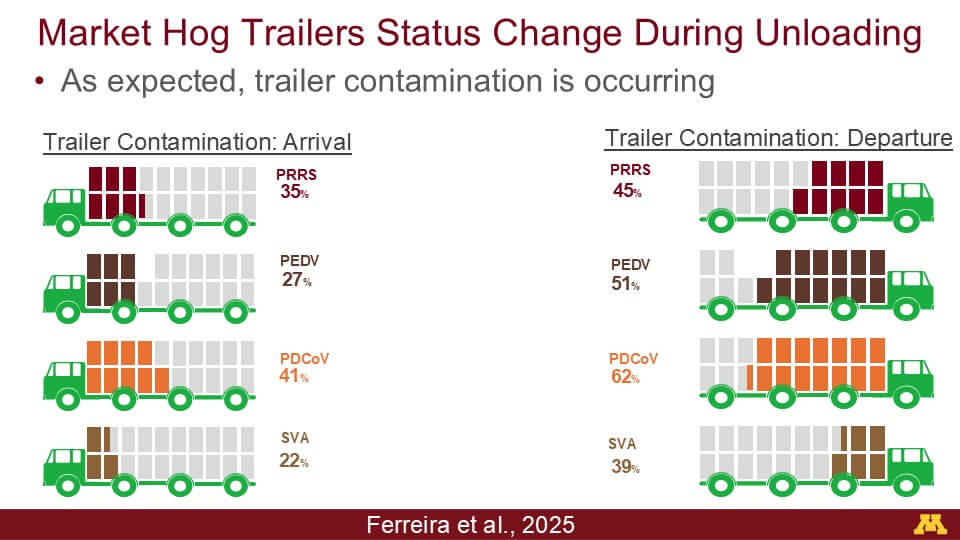
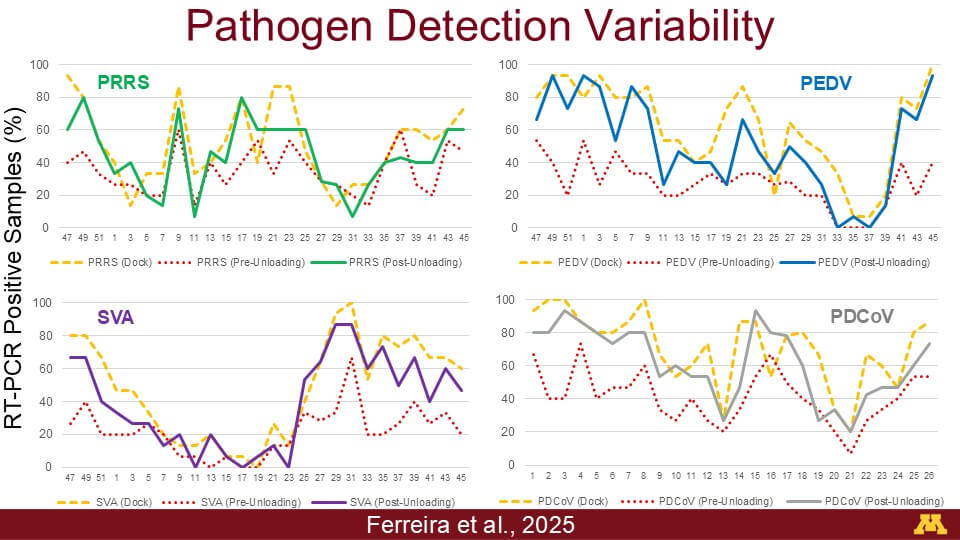
Harvest facilities are recognized as important nodes in the swine industry that contribute to disease transmission networks, yet quantitative data describing environmental contamination dynamics remain limited. The primary objectives of the study were to determine whether trailer contamination increases during pig unloading at the harvest plant and to identify factors such as seasonality, trailer sanitation practices, and driver behaviors that contribute to contamination risk. The study evaluated the occurrence of four swine viruses: porcine reproductive and respiratory syndrome virus (PRRSV), porcine deltacoronavirus (PDCoV), porcine epidemic diarrhea virus (PEDV), and Senecavirus A (SVA) in a commercial harvest plant located in the Midwest. Depending on the virus, between half and over seventy percent of dock samples tested positive. This indicates that the unloading area is a major hotspot for pathogen presence. A substantial proportion of trailers were already contaminated when they arrived at the plant; however, contamination levels increased further after unloading for all viruses evaluated. This demonstrates that trailers not only bring pathogens into the facility but can also acquire additional contamination during the unloading process.
To perform the study, sampling was conducted every two weeks over a one-year period at the commercial harvest facility. Prior to pig unloading, drivers were approached and asked to participate in a short biosecurity trailer survey. If drivers agreed, surveys were completed immediately and data was collected on trailer cleanliness, trailer origin and destination, driver biosecurity practices during unloading, and whether plant employees enter the trailer during the unloading process. Environmental samples were then collected from 1) the unloading dock, 2) the trailer upon arrival before unloading pigs, and 3) the same trailer after unloading prior to departure. Trailer samples were collected by rubbing a sterile cloth moistened with media across a 1ft x 1ft floor area of the compartment in front of the trailer back door.
A total of 389 environmental samples were collected across 26 sampling events and tested via PCR to detect viral genetic material. Additional information gathered during each visit included temperature and humidity, trailer cleaning and disinfection protocols, type of animals transported, unloading conditions, and driver-related factors such as personal protective equipment use, training, and experience.
Results showed that unloading docks are consistently contaminated at high rates throughout the year. Detection of pathogens across dock samples had positivity rates of 71.2% for PDCoV, 61.9% for PEDV, 51.7% for PRRSV, and 48.1% for SVA. Many trailers arrived at the harvest plant already contaminated; however, contamination rates increased further after unloading for all the pathogens studied. Notably, 74.6% of trailers that arrived negative for all tested viruses departed contaminated with at least one pathogen, confirming that unloading market hogs at harvest facilities can serve as important amplification points for disease spread.
Distinct seasonal patterns were also observed. PDCoV and PEDV were detected more frequently during winter and fall months, with contamination at the dock 4 – 10X higher in these seasons compared to summer. PRRSV had higher detection during fall and spring, while SVA showed increased contamination risks during warmer summer periods. These findings suggest that environmental conditions influence viral detection dynamics perhaps as a consequence of viral transmission in the finishing pig population which leads to hauling actively shedding pigs to the plant, highlighting the need for year-round biosecurity vigilance.
Trailer sanitation practices were among the most important controllable risk factors identified through the survey. Trailers that were properly washed, disinfected, and dried before arrival had significantly lower contamination rates than inadequately sanitized trailers. In addition, trailers used for both swine and cattle transport showed higher contamination risk for certain pathogens, suggesting that multi-species transport may be contributing to pathogen spread.
The study also identified opportunities to improve driver biosecurity awareness and training. Many drivers reported using PPE primarily for cleanliness rather than disease prevention, and formal biosecurity education was often limited in scope. Inconsistent PPE use and inadequate understanding of disease transmission may increase the risk of indirect pathogen spread through contaminated clothing and equipment during transportation.
Key Observations:
Overall, findings demonstrate that harvest facilities represent critical control points in swine pathogen dissemination. The study provided evidence that trailer contamination increases after unloading, showing cross-contamination between docks and transport vehicles. The interaction between contaminated docks and trailers creates an ongoing cycle of contamination that can transport pathogens back to farms. These results reinforce the importance of assuming all trailers returning from harvest facilities are contaminated and ensuring they undergo thorough cleaning, disinfection, and drying prior to reuse. Enhanced seasonal biosecurity measures, improved driver training, minimizing unloading risks, and avoiding multi-species transport provide opportunities to reduce pathogen transmission and help protect herd health.
Foundation for Food & Agriculture Research
The Foundation for Food & Agriculture Research (FFAR) builds public-private partnerships to fund bold research addressing big food and agriculture challenges. FFAR was established in the 2014 Farm Bill to increase public agriculture research investments, fill knowledge gaps and complement the U.S. Department Agriculture’s research agenda. FFAR’s model matches federal funding from Congress with private funding, delivering a powerful return on taxpayer investment. Through collaboration and partnerships, FFAR advances actionable science benefiting farmers, consumers and the environment.
Swine Health Information Center
The Swine Health Information Center, launched in 2015 with Pork Checkoff funding, protects and enhances the health of the US swine herd by minimizing the impact of emerging disease threats through preparedness, coordinated communications, global disease monitoring, analysis of swine health data, and targeted research investments. As a conduit of information and research, SHIC encourages sharing of its publications and research. Forward, reprint, and quote SHIC material freely. For more information, visit http://www.swinehealth.org or contact Dr. Megan Niederwerder at [email protected] or Dr. Lisa Becton at [email protected].