As an outcome of the Swine Health Information Center Wean-to-Harvest Biosecurity Research Program, in partnership with the Foundation for Food & Agriculture Research and Pork Checkoff, a newly published paper in Veterinary Sciences outlines risk and protective factors for PRRSV outbreaks identified through an industry-wide biosecurity survey. Utilizing a questionnaire to gather data, the survey project completed in April 2025 reported biosecurity practices across 3,680 sites. In a second study, 95 wean-to-harvest sites were followed with monthly oral fluid testing for PRRSV. Researchers characterized which practices increased or decreased the likelihood of a PRRS outbreak. Risk factors included transporting pigs of unknown PRRSV status, rendering mortalities, and employees working across multiple sites living together. Protective factors included assigned vehicle parking, farm-owned equipment, and overnight downtime for caretakers working across multiple sites.
Find the full paper in Veterinary Sciences here and the industry summary for project #23-029 on this page. Read more about the Wean-to-Harvest Biosecurity Research Program here.
Led by Drs. Mariah Musskopf and Gustavo Silva at Iowa State University, this study assessed current bioexclusion practices among a diverse group of producers across swine-producing states in the US. In addition, the study developed methods that veterinarians, production managers, and producers could implement to improve on-farm biosecurity including the development of a risk assessment tool. Overall, findings showed that biosecurity on wean-to-harvest sites is inconsistent across the industry and that tools for increasing biosecurity could include relatively simple practices such as bench entry.
To assist with the management of increased PRRS activity detected during winter months, SHIC is highlighting the project information regarding risk and protective factors from PRRSV outbreak data to help producers, veterinarians, and other stakeholders apply key learnings from the project. In the forest plot graph (Figure 1), odds ratios for various biosecurity and management practices associated with PRRSV outbreaks are displayed. Practices with odds ratios above 1 indicate increased odds of outbreak (red dots), while those below 1 suggest protective effects (green dots).
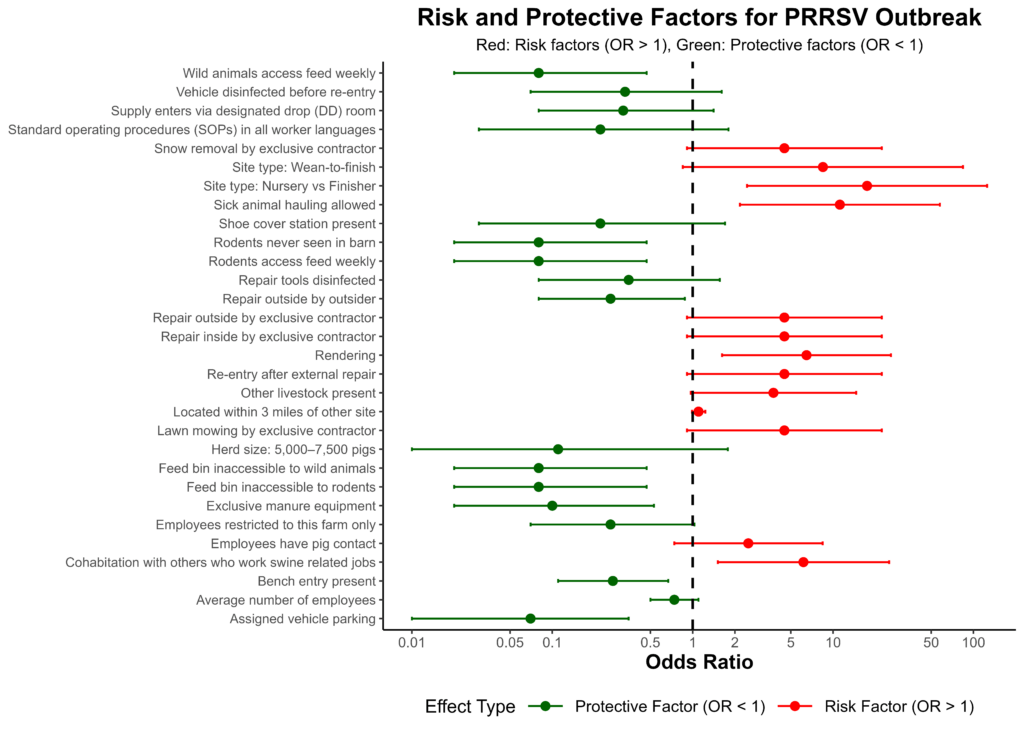
Figure 1. Risk and protective factors for PRRSV outbreaks based on biosecurity questionnaires and monthly oral fluids testing for PRRSV. Reprinted from Musskopf, M., et al., Vet. Sci. 2025, https://doi.org/10.3390/vetsci12101000.
Among the practices evaluated, transporting pigs with unknown PRRSV status, using rendering for mortality management, and workers cohabitating with others who work swine-related jobs were significantly associated with higher likelihood of PRRS outbreaks. Researchers noted that sites where employees cohabitated with others involved in swine-related work had 6.15 times higher odds of a PRRS outbreak (95% CI: 1.51–25.09, p = 0.011). Sites using rendering for carcass disposal had 6.47 times higher odds of a PRRS outbreak compared to sites that did not use rendering (95% CI: 1.62–25.84, p = 0.008).
In contrast, the researchers said that practices such as maintaining a defined parking space decreased the likelihood of a PRRSV outbreak (OR = 0.07, 95% CI: 0.01–0.35, p = 0.001). Further, sites that used exclusive pumping equipment owned by the farm and used at a single location were associated with significantly lower odds of a PRRS outbreak (OR = 0.07, 95% CI: 0.01–0.43, p = 0.003). Practices or on-farm characteristics found to reduce the likelihood of a PRRSV outbreak are highlighted in green and suggest a protective effect.
These findings highlight the need for targeted biosecurity measures, especially in the finisher phase, where the risk of PRRSV outbreaks is higher. Results underscore the importance of implementing effective biosecurity practices, such as regular washing, downtime, and preventing sick animal transport, to mitigate the risk of PRRSV transmission and protect the health of the US swine herd.
Reference
Musskopf, M.; Peterson, T.; Machado, I.; Tran Pham Tien, T.; Kirwa, E.; Carnevale de Almeida Moraes, D.; Cezar, G.; Mil-Homens, M.; Li, P.; De Conti, E.; et al. Assessment of the Relationship Between Bioexclusion Practices Applied in Wean-to-Harvest Sites and PRRS Outbreaks. Vet. Sci. 2025, 12, 1000. https://doi.org/10.3390/vetsci12101000.
Foundation for Food & Agriculture Research
The Foundation for Food & Agriculture Research (FFAR) builds public-private partnerships to fund bold research addressing big food and agriculture challenges. FFAR was established in the 2014 Farm Bill to increase public agriculture research investments, fill knowledge gaps and complement the U.S. Department Agriculture’s research agenda. FFAR’s model matches federal funding from Congress with private funding, delivering a powerful return on taxpayer investment. Through collaboration and partnerships, FFAR advances actionable science benefiting farmers, consumers and the environment.
Swine Health Information Center
The Swine Health Information Center, launched in 2015 with Pork Checkoff funding, protects and enhances the health of the US swine herd by minimizing the impact of emerging disease threats through preparedness, coordinated communications, global disease monitoring, analysis of swine health data, and targeted research investments. As a conduit of information and research, SHIC encourages sharing of its publications and research. Forward, reprint, and quote SHIC material freely. For more information, visit http://www.swinehealth.org or contact Dr. Megan Niederwerder at [email protected] or Dr. Lisa Becton at [email protected].