New World Screwworm: Fact Sheet & SHIC Article 6/10/2026 & USDA NWS Website & SHIC/AASV NWS Webinar (8/4/2026)
New Tool for Monitoring Endemic Swine Pathogens
A Swine Health Information Center-funded project at Iowa State University developed a data-driven etiology index to help characterize the relative activity of endemic swine pathogens in the US. The work, led by Drs. Giovani Trevisan and Daniel Linhares, uses confirmed tissue-based diagnoses from the Iowa State University Veterinary Diagnostic Laboratory to rank disease activity and identify emerging changes over time.
The full study has been published in Transboundary and Emerging Diseases here.
The industry summary for SHIC project 24-016 can be found by searching here.
The disease index was also the subject of the Swine Disease Reporting System Bonus Page here (p 10-11).
This initiative aimed to provide a transparent, automated, and reproducible method to help veterinarians, producers, and stakeholders prioritize disease threats based on real-world diagnostic data. The research analyzed 59,950 porcine tissue cases submitted to the ISU-VDL between 2020 and 2024, including evaluation of 81 bacterial, viral, parasitic, and metabolic/intoxication etiologies. Rather than relying solely on the number of diagnoses, the resulting index combines four measures: disease occurrence, co-diagnosis with other etiologies, geographic distribution across states, and Early Aberration Reporting System (EARS) alarms. The variables are weighted according to their contribution to the overall index, with disease occurrence receiving the greatest weight (0.50), followed by EARS alarms (0.26), state occurrence (0.15), and co-diagnosis (0.09).
The resulting index (Table 1) ranges from 0.01 to 1 and is designed to show relative etiology activity and changes in ranking over time—not national disease prevalence or incidence. This distinction is important because diagnostic laboratory submissions can be influenced by factors such as producer awareness, sample submission practices, logistics, and economic conditions. In addition, some diseases are more commonly identified through diagnostic methods other than confirmed tissue diagnoses and therefore may be underrepresented in this dataset.
Table 1. The 10 diseases/etiologies that received the highest indexes in 2024 after multiplying each variable’s results by its respective weight.
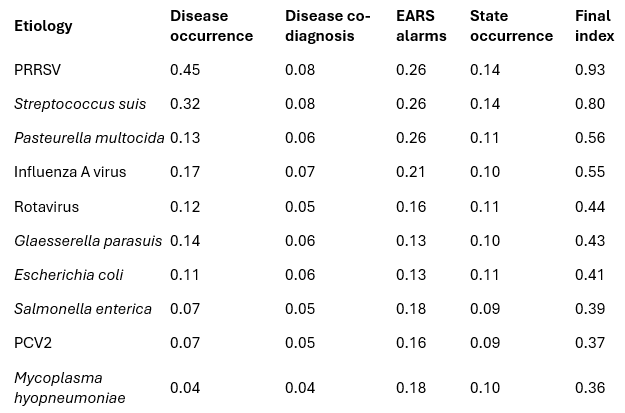
Results demonstrated strong year-to-year stability in the index. PRRSV and Streptococcus suis consistently ranked among the highest-activity etiologies, while Pasteurella multocida and influenza A virus also remained important. At the same time, the index identified changes that may warrant additional attention. Porcine sapovirus and porcine astrovirus showed increased activity and geographic distribution, indicating risks for potential emergence, while PCV2 demonstrated a notable decline in ranking and fell outside the top 10 by 2024. Bootstrap analysis also identified PCV2’s 2024 activity as an atypical change relative to the expected distribution based on previous data.
An important strength of the approach is its ability to integrate multiple dimensions of diagnostic information into a single, interpretable measure. The index can help distinguish pathogens that consistently represent a substantial endemic burden from those showing more recent or unusual changes in activity. It also provides a framework that can be adapted to additional diagnostic laboratories, pathogens, production systems, or livestock species.
The index results are available through an interactive Power BI dashboard (scroll to bottom of SDRS dashboard page) that allows users to examine individual etiologies and compare their index values across years. The dashboard is designed to be updated as new diagnostic data become available, providing a mechanism for continued monitoring rather than a one-time assessment.
The completed research provides a scalable and reproducible framework for using routinely collected diagnostic information to support evidence-based swine health decision-making. By combining frequency, geographic distribution, co-diagnosis, and signals of unusual activity, the etiology index offers another tool for identifying changing disease priorities and strengthening surveillance of endemic and reemerging swine pathogens.
Overall, the index presents a transparent foundation for swine disease prioritization, enabling continuous, longitudinal monitoring that differentiates between stable endemic pathogens and volatile or emerging threats.
Reference: Cezar, Guilherme A., Zhang, Danyang, Main, Rodger G., Burrough, Eric R., Nicolino, Rafael R., da Costa, Maria Rodrigues, Silva, Gustavo, Linhares, Daniel C. L., Trevisan, Giovani, Generation of an Etiology Index Based on Confirmed Tissue Diagnosis Data to Assess Endemic Swine Etiology Activity in the United States of America, Transboundary and Emerging Diseases, 2026, 9910689. https://doi.org/10.1155/tbed/9910689
The Swine Health Information Center, launched in 2015 with Pork Checkoff funding, protects and enhances the health of the US swine herd by minimizing the impact of emerging disease threats through preparedness, coordinated communications, global disease monitoring, analysis of swine health data, and targeted research investments. As a conduit of information and research, SHIC encourages sharing of its publications and research. Forward, reprint, and quote SHIC material freely. For more information, visit https://www.swinehealth.org or contact Dr. Megan Niederwerder at [email protected] or Dr. Lisa Becton at [email protected].